Agent Readiness Is the New SEO — And Most Sites Are Already Behind

Ten years ago, if your website wasn't indexed by Google you effectively didn't exist. Companies spent fortunes on SEO — structured data, canonical tags, sitemap files, meta descriptions — all to make sure a machine could read and rank their content correctly. Most of that investment paid off handsomely.
We're at the same inflection point again, except the machine is no longer a crawler. It's an agent. And agents don't read pages the way search bots do.
How Agents Actually Find Your Business
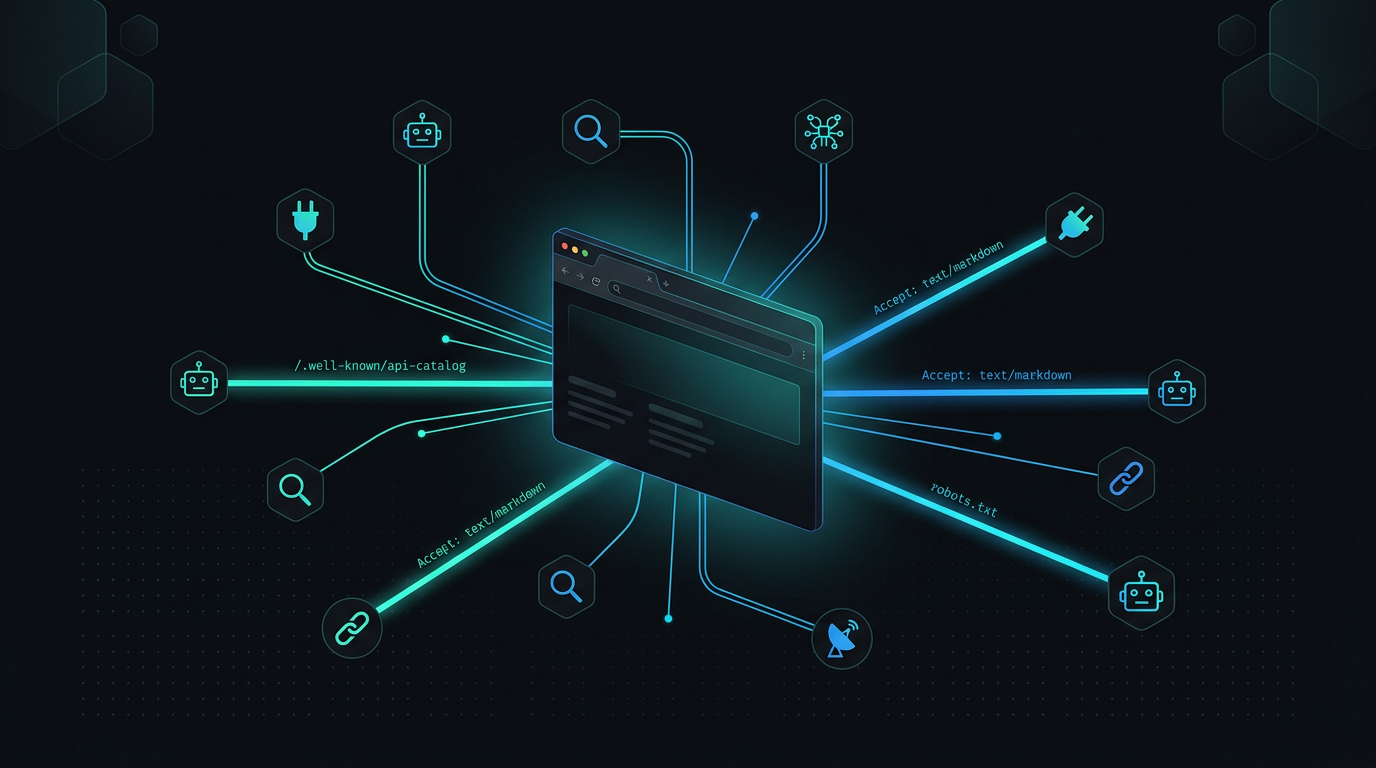
When a user asks Claude, ChatGPT, or Gemini to "find me a good AI product studio in Lisbon" or "book a UX consultation for my blockchain project," the agent doesn't fire up a browser and scroll through search results. It makes structured HTTP requests, inspects response headers, reads machine-readable files, and follows standardized discovery protocols. If your site doesn't speak those protocols, it doesn't exist in that conversation — no matter how good your Google ranking is.
The technical standards driving this shift have names most developers haven't heard yet: RFC 8288 Link headers, RFC 9727 API catalogs, MCP Server Cards, Content Signals, WebMCP, OAuth Protected Resource Metadata, and x402 payment rails. Together they form a new stack — an "agent-readiness stack" — that determines whether an autonomous system can discover, understand, and transact with your product.
The Five Pillars of Agent Readiness
At Lopezi we break agent readiness into five categories that mirror the way agents operate when they first encounter a new site.
Discoverability is the foundation. Your robots.txt needs explicit AI-bot directives, your sitemap must be current, and your homepage should return Link response headers that point machines to your API catalog and content resources. Without these, most agents stop at the door.
Content accessibility comes next. Browsers request HTML. Agents prefer Markdown. When an agent sends an Accept: text/markdown header, your server should respond with a clean Markdown version of the page and a Content-Type: text/markdown header — not another blob of HTML that the agent has to parse and strip. This single change dramatically reduces token waste and hallucination risk.
Bot access control is where you declare your policies. The emerging Content Signals standard lets you embed a single line in robots.txt — Content-Signal: ai-train=no, search=yes, ai-input=yes — and instantly tell every compliant agent what it may do with your content. Clear policies build trust; missing policies get guessed incorrectly.
Protocol discovery is the layer most businesses are completely unprepared for. An MCP Server Card at /.well-known/mcp/server-card.json tells agent clients how to connect to your backend. An Agent Skills index at /.well-known/agent-skills/index.json packages your domain expertise as portable, version-controlled skill files that agents load on demand. A WebMCP implementation registers your site's key actions directly in the browser so agents can navigate and transact without guessing the DOM. An API catalog at /.well-known/api-catalog publishes your endpoints in the RFC 9727 Linkset format. Get these right and your product becomes a first-class citizen in the agentic ecosystem.
Agentic commerce is the frontier. x402, MPP, UCP, and ACP are emerging payment rails that let agents pay for services on your behalf — micropayments for API calls, subscriptions, one-click checkouts — without requiring the user to enter a card number. Early adopters here will have a significant advantage as agent-driven purchasing becomes mainstream.
What a Readiness Gap Actually Costs You
Consider two identical SaaS products. Product A has implemented agent-readiness standards. Product B hasn't. When an agent is asked to "set up project management for my team," it finds Product A's MCP Server Card, reads its capabilities, connects to the API, and completes the integration autonomously. Product B gets skipped — not because its features are worse, but because the agent hit a dead end and moved on.
This is the SEO parallel made concrete. Being invisible to agents doesn't just mean fewer discovery impressions. It means losing the entire transaction — the sign-up, the integration, the revenue — to a competitor who did the plumbing work.
How We Help at Lopezi
We've spent the past several months implementing every major agent-readiness standard across live production sites — including this one. We know exactly where the complexity hides, which standards are mature enough to prioritize, and which are still too early to bet on.
Our engagement starts with a free readiness scan: an automated audit across all five categories with a scored report and a 30-minute call to walk through the gaps. Most teams leave that call with a clear, prioritized implementation plan — and a realistic sense of what's a weekend fix versus a two-week project.
For teams ready to move, our Implementation package (from €4,900) covers the baseline: robots.txt, Link headers, Markdown negotiation, sitemap hygiene. The Protocol Discovery engagement (from €7,500) adds MCP, OAuth, Agent Skills, WebMCP, and API catalog work. Enterprise teams building agent-native commerce get a custom scoped engagement.
We're not a consultancy that hands you a report and disappears. We ship the code, configure the endpoints, verify the scanner passes, and hand over clean documentation. If you're on Vercel, Express, Next.js, or a static host, we've already done it on those stacks.
The Window Is Short
The businesses that invest in SEO early in a search engine's lifecycle get compounding returns — trust signals, backlinks, indexed pages — that latecomers spend years trying to replicate. Agent readiness is following the same curve. The standards are being written now. The agents are being trained now. The habits that determine which sites get recommended, integrated, and transacted with are being formed now.
A free 30-minute scan is a low-cost way to find out exactly where you stand. Book one at calendly.com/lopezi/ and we'll send your report before the call. No sales pitch, just the data — and an honest conversation about whether and how we can help.
Ready to ship agents you can trust?
Let's map one workflow worth handing to an agent — and what it would take to govern it.
Schedule a consultation