Stop Counting Tokens. Start Measuring Cost Per Outcome

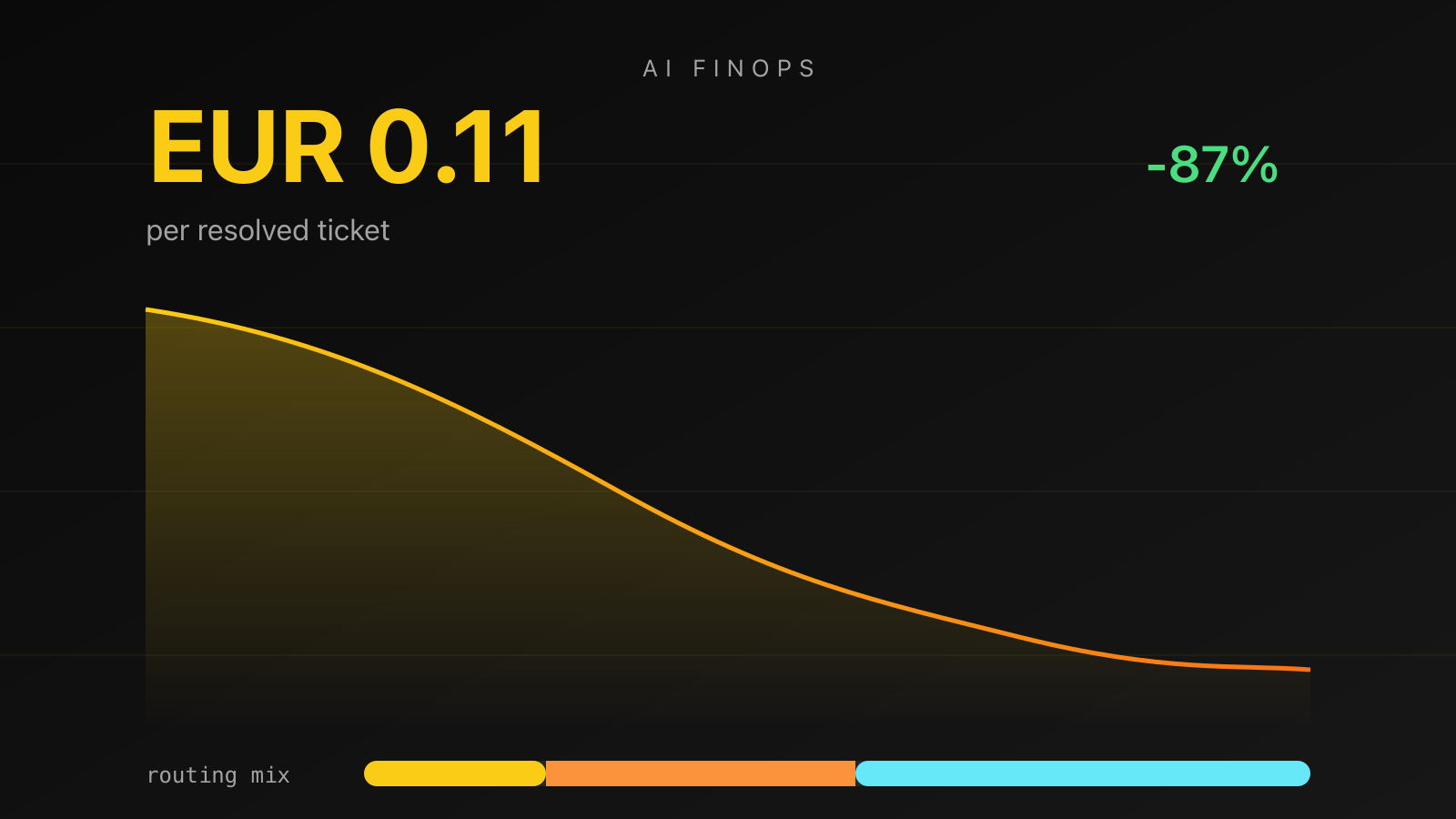
Most AI dashboards still celebrate tokens. Tokens are inventory, not value. The question that matters in production is: what did it cost to resolve the ticket, close the claim, draft the report, or complete the checkout — and did quality hold? That shift, from token accounting to outcome accounting, is what we call AI FinOps.
Why tokens lie
A frontier model that solves a task in one pass can be cheaper than a mid-size model that retries five times. A cached system prompt can dominate the bill more than the completion. A retrieval hop that pulls irrelevant chunks burns money and invites hallucination. Looking at spend per million tokens without task success, latency, and human escalations is how teams "optimise" themselves into worse products.
Route every task to the smallest model that passes
Cascades work. Classify the request. Send the easy majority to a small or mid-size model — or a distilled specialist. Escalate to a frontier model only when evals or confidence demand it. Keep an open-weight path for data that cannot leave your boundary. The mix shifts week to week; the rule does not: no model gets traffic it has not earned on the suite.
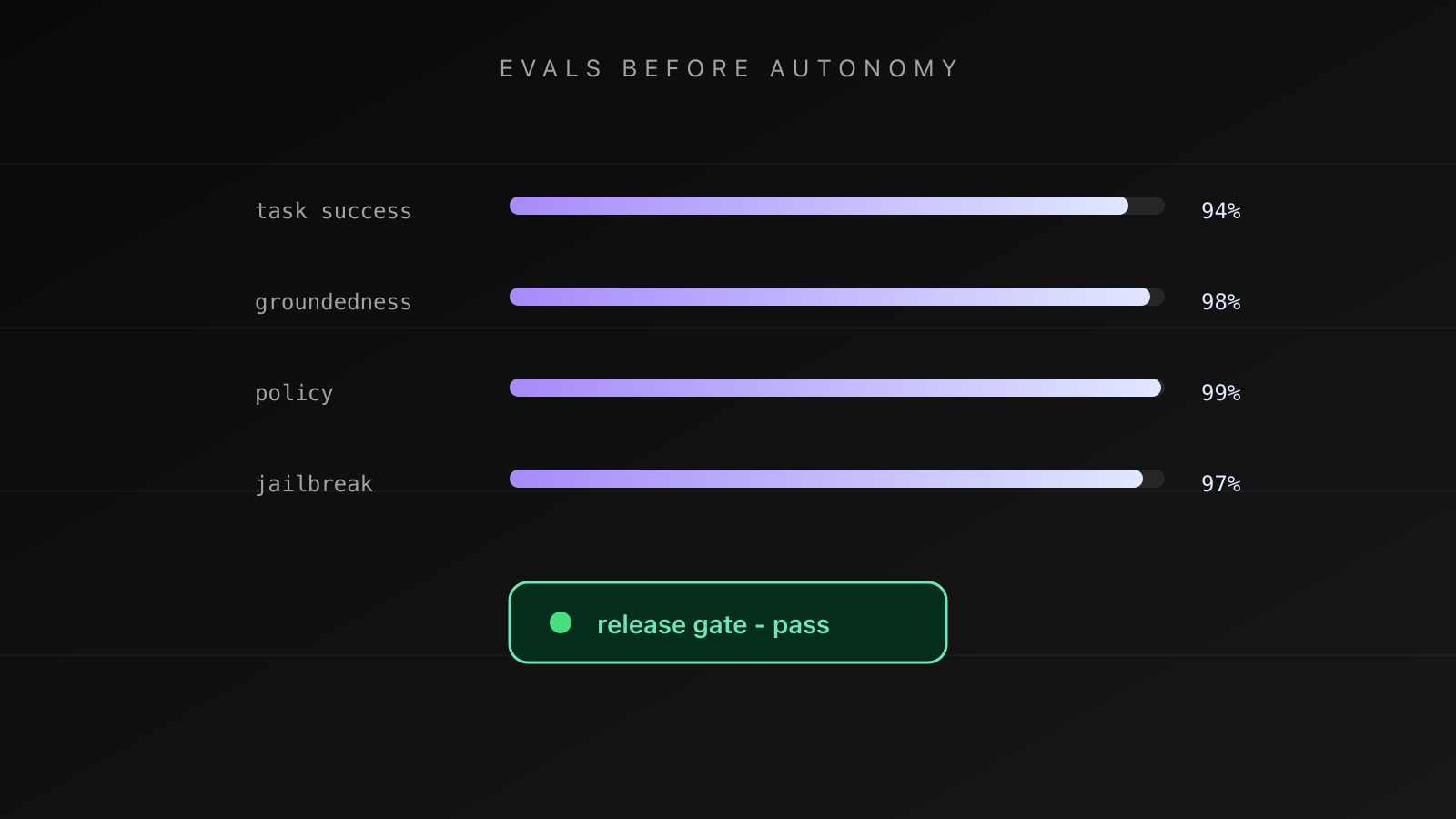
This is where evals and economics meet. Without a release gate, routing becomes a cost-cutting contest. With a gate, routing becomes quality-preserving spend. We have seen support workflows drop from roughly €0.80+ per resolved ticket to low teens of cents while holding or improving task success — not by prompting harder, but by refusing to use a frontier model for every classification and template reply.
Cache, batch, distill, go to the edge
Prompt caching turns stable instructions and tool schemas from recurring cost into amortised cost. Batch APIs absorb offline jobs. Distillation captures a teacher's behaviour in a cheaper student for high-volume paths. On-device and edge inference remove round trips for private or latency-sensitive steps. None of these is glamorous. All of them compound.
Dashboards that finance will trust
Replace vanity charts with cost per successful outcome, cost per escalation avoided, p95 latency, and eval pass rate by version. Attribute spend to product surfaces and agent skills, not to a single "AI" cost centre. Set budgets and circuit breakers the same way you would for cloud FinOps — because runaway agents are a FinOps incident with a probabilistic twist.
Intelligence at the right price
The goal is not the cheapest model. It is the cheapest path that still passes the bar you set for trust. That bar is an engineering artefact: evals, routing tables, caches, and dashboards. Get those right and AI scales with margin instead of against it.
If your token bill is growing faster than the outcomes you can prove, we help teams redesign the routing and measurement layer — then ship it. Start with a call at calendly.com/lopezi/ and bring one workflow's real costs. We will sketch the cascade on the whiteboard before you leave.
Ready to ship agents you can trust?
Let's map one workflow worth handing to an agent — and what it would take to govern it.
Schedule a consultation